A forklift service is more than an oil change. A good service checks the parts that keep the forklift safe and reliable, replaces what’s worn, and picks up small faults before they turn into a breakdown. Here’s what a typical forklift service includes, and how it differs between LPG, petrol and electric forklifts.
Why regular servicing matters
WorkSafe Victoria’s guidance says forklifts and their attachments must be regularly inspected and maintained, and recommends using a suitably competent forklift technician so the forklift keeps operating in line with the manufacturer’s recommendations. Regular servicing helps you:
- Keep the forklift safe for operators and people nearby
- Reduce unplanned breakdowns and downtime
- Catch wear early, when parts are cheaper to replace
- Keep a service history, which helps resale value
Most forklifts get a scheduled service somewhere between every 250 and 500 hours, or every three to six months. That’s a typical range only. Your manufacturer’s schedule and how hard the forklift works set the right interval.
What’s checked on every forklift
Whatever the fuel type, a scheduled service usually covers these areas.
Mast, chains and forks
The technician checks the mast for wear, damage and smooth operation, inspects the lift chains for stretch, wear and lubrication, and looks over the forks for cracks, bends and heel wear. Chains are adjusted and lubricated as needed.
Hydraulics
Hydraulic fluid level and condition are checked, along with hoses, fittings and cylinders for leaks or damage. Slow lifting, jerky movement or a mast that drifts down can point to a hydraulic fault.
Brakes and steering
Service and park brakes are tested and adjusted, and the steering is checked for play, leaks and smooth operation.
Tyres and wheels
Tyres are checked for wear, chunking and damage, and wheel nuts for tightness. Worn tyres affect stability and braking, so they’re flagged early.
Safety equipment
The seatbelt, horn, lights, reversing beeper or warning devices, overhead guard and load backrest are all checked to make sure they work and aren’t damaged.
Lubrication
Grease points across the mast, steering and chassis are lubricated to reduce wear.
Extra checks for LPG and petrol forklifts
Internal combustion forklifts have an engine to look after, so a service typically also includes:
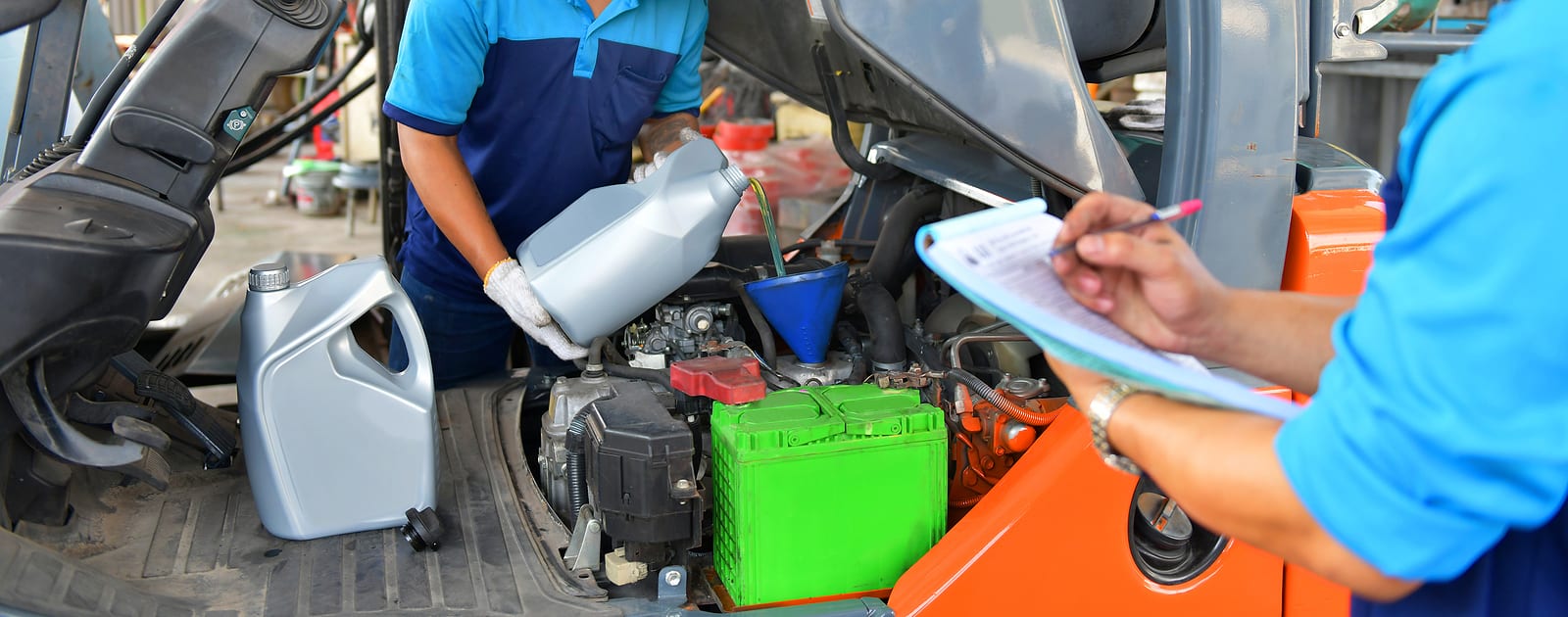
- Engine oil and oil filter change
- Air filter check or replacement, especially in dusty sites
- Spark plugs and ignition checks, depending on the schedule
- Cooling system: coolant level, radiator and hoses
- Fan belts and drive belts
- Fuel system: on LPG forklifts, the gas bottle bracket, hoses, connections and regulator; on petrol forklifts, fuel lines and filters
- Exhaust system for leaks and damage
Not every item is replaced at every service. Some parts are changed at set hour intervals, so a bigger service may come around every few services.
Extra checks for electric forklifts
Electric forklifts skip the engine work, but the electrical system needs care:
- Battery condition, terminals and cables
- Water levels on lead-acid batteries
- Charger operation and charging connections
- Drive and lift motors
- Controllers, contactors and wiring
If an electric forklift won’t hold its charge through a shift, ask about our battery and charger work.
The test drive and report
A service should finish with a test of the forklift under normal operation: driving, braking, steering, lifting, lowering and tilting. You should then get a clear report of what was done, what was replaced, and anything that needs attention soon. Keep it with your service records. WorkSafe Victoria’s guidance recommends keeping inspection and maintenance records that show what was inspected, any maintenance carried out, and any defects and rectification work.
What a service doesn’t replace
Operators should still do a pre-start check before using the forklift. WorkSafe Victoria recommends a pre-operation inspection, in line with the manufacturer’s recommendations, at the start of each shift, before first daily use and when the operator changes. A service also isn’t a repair: if the technician finds a worn part or a fault, it’s quoted separately so you can decide.
If your forklift has already broken down, see our forklift repairs in Melbourne page.
Our forklift service in Melbourne
We’ve been servicing forklifts across Melbourne since 2009, and we mainly work on Toyota forklifts. For other makes, call and ask and we’ll tell you straight whether we can help.
- Service special: $345 + GST (normally $450 + GST) for gas, petrol and electric forklifts up to 3 tonnes.
- On-site, anywhere in Melbourne. We come to you.
- Multi-unit discounts for sites with more than one forklift.
- Safety inspections, battery and charger work, and petrol forklift repairs are also available.
Read more on our forklift service and repair page, or see your local page: Werribee, Epping, Laverton North, Altona, Thomastown and Broadmeadows.
Need a forklift while yours is serviced?
Most services are done on site without taking the forklift away for long. If a repair keeps it off the road, forklift hire starts from $30/day + GST with servicing and breakdown cover included. If it’s time to replace an old machine, browse our used forklifts for sale in Melbourne, with up to a 3-year warranty.
Book a service
Tell us the make, model, hours on the meter and your site address. We’ll quote before we come out, and we reply within 1 hour during business hours, Monday to Friday, 8am–4pm.