

Got a shipping container arriving and no forklift to unload it? Short-term forklift rental is a simple fix. Here’s what to plan for in Melbourne.
What kind of forklift unloads a container?
To drive into a shipping container, a forklift usually needs a container mast, which is low enough to fit through the door. Pallet weights and how the load is packed matter too. Call 1300 326 654 with the container size, the pallet weights and the date, and we’ll tell you what we can supply.
How long to hire for
Our minimum hire is generally one week. That suits one container or a run of deliveries. If containers arrive regularly, ask about long-term forklift hire.
What it costs
- $180–$250 + GST per week for a late-model Toyota 1.8–2.5t container mast forklift.
- Delivery from around $180 + GST, quoted by suburb.
- Servicing and breakdown cover included for the whole hire.
See forklift rental cost in Melbourne for how pricing works.
LPG or electric for container work?
LPG (gas) forklifts suit yards, loading docks and trucks, which is where most containers are unloaded. Electric forklifts suit indoor work. See LPG forklift hire and electric forklift hire.
Before the container arrives
- Book the forklift so it’s on site before the container.
- Make sure whoever drives it holds a forklift licence. See when forklift training is required.
- Check the ground where the forklift will work is firm and level.
Container unloading FAQs
Can you supply a container mast forklift?
Call 1300 326 654 with your container size, pallet weights and dates, and we’ll tell you what we can supply.
What is the minimum hire?
Generally one week.
Do you deliver?
Yes. Delivery starts from around $180 + GST, quoted by suburb, from our Werribee and Epping yards.
Where can I read more?
See our guide to container forklift hire in Melbourne. For rates and what’s included on every hire, see forklift rental Melbourne and forklift rental cost.
Forklift hire Melbourne for one container or a busy week
Whether you call it hire or rental, Damoli delivers a Toyota forklift to your site across Melbourne, with servicing and breakdown cover included for the whole hire. Call 1300 326 654 with the container size, pallet weights and dates.
Forklift rental in Melbourne at Damoli is priced by the week, not the day. A Toyota 1.8 tonne LPG forklift is $190 a week + GST, or $160 a week when you hire for a month or more. Minimum hire is generally one week, and servicing and breakdown cover are included for the whole hire.
Daily vs weekly forklift rental
We don’t do daily hire. Our minimum hire is generally one week. If you only need a forklift for a day or two, another dealer that does daily hire will suit you better. If the job runs a week or longer, weekly forklift rental works out simpler: one rate, servicing included, and delivery quoted up front from around $180 + GST.
- Toyota LPG 1.8 tonne, standard mast — $190 a week + GST ($160 a week on a month or more)
- Toyota LPG 1.8 tonne, container mast — $230 a week + GST ($200 a week on a month or more)
- Toyota LPG 2.5 tonne, standard mast — $200 a week + GST ($180 a week on a month or more)
- Toyota LPG 2.5 tonne, container mast — $250 a week + GST ($200 a week on a month or more)
- Electric counterbalance forklift — $270 a week + GST ($210 a week on a month or more)
- Electric reach truck — $280 a week + GST ($220 a week on a month or more)
What’s included in the rental price
- Servicing and breakdown cover for the whole hire.
- A Toyota forklift matched to the job: LPG (gas) for yards, docks and trucks, or electric for indoor work.
- Hire now, pay later. Set up an account in under 5 minutes.
Delivery: the cost to plan for
Delivery starts from around $180 + GST and is quoted by suburb before you book. Because delivery is a one-off cost, the longer you hire, the less it adds to each week.
How to cut the cost
Hire for a month or more and the weekly rate drops by $20–$60, depending on the machine. On hires over a month, ask us about reduced delivery. Need more than one machine? Call 1300 326 654 and we’ll quote them together.
How to get an accurate quote
Call 1300 326 654 and tell us:
- The heaviest load and how high it needs to go.
- Indoors, outdoors, or both.
- How long you need it.
- Your site address.
We’ll quote the hire and delivery before you book. See 1.8 tonne, 2.5 tonne and 3 tonne hire, or short-term and long-term forklift hire.
Forklift rental cost FAQs
Can I rent a forklift for one day?
No. We don’t do daily hire; the minimum hire is one week. For a week or longer, call 1300 326 654.
How much is a forklift per week in Melbourne?
From $190 a week + GST for a Toyota 1.8 tonne LPG forklift ($160 a week on a month or more). Container mast forklifts are $230–$250 a week + GST. Delivery is from around $180 + GST.
Is servicing included?
Yes. Servicing and breakdown cover are included for the whole hire.
Is it better to hire or buy?
It depends on how long you need it. See forklift hire vs buying, or browse used forklifts for sale in Melbourne, with a 3-year warranty on all units.
Forklift hire Melbourne: what else to plan for
Forklift hire Melbourne with Damoli also means a hire fleet of 150+ machines, mainly Toyota, and two yards: Werribee (Monday to Friday 8am–4pm) and Epping (Monday to Friday, midnight to 4pm). Unloading a container? See short-term forklift rental for containers and container forklift hire.
Still deciding whether to rent or buy? Read forklift hire vs buying. See current weekly rates on our forklift hire Melbourne page or call 1300 326 654.
A shipping container has landed, the truck is booked and you need a forklift that can actually get inside it. This guide covers what to hire for container unloading in Melbourne: why the mast matters more than you might think, what capacity suits most containers, gas or electric, and whether to hire for a week, hire long term or buy.
Short answer: for most containers of palletised goods, Melbourne businesses hire a Toyota 1.8 to 2.5 tonne forklift with a container mast. Weekly hire of a late-model Toyota 1.8 to 2.5 tonne container mast forklift is $180 to $250 + GST per week, minimum hire is generally one week, and delivery is from around $180 + GST depending on your suburb. Servicing and breakdown cover are included for the whole hire. See all options on our forklift hire Melbourne page.
Why a container mast matters
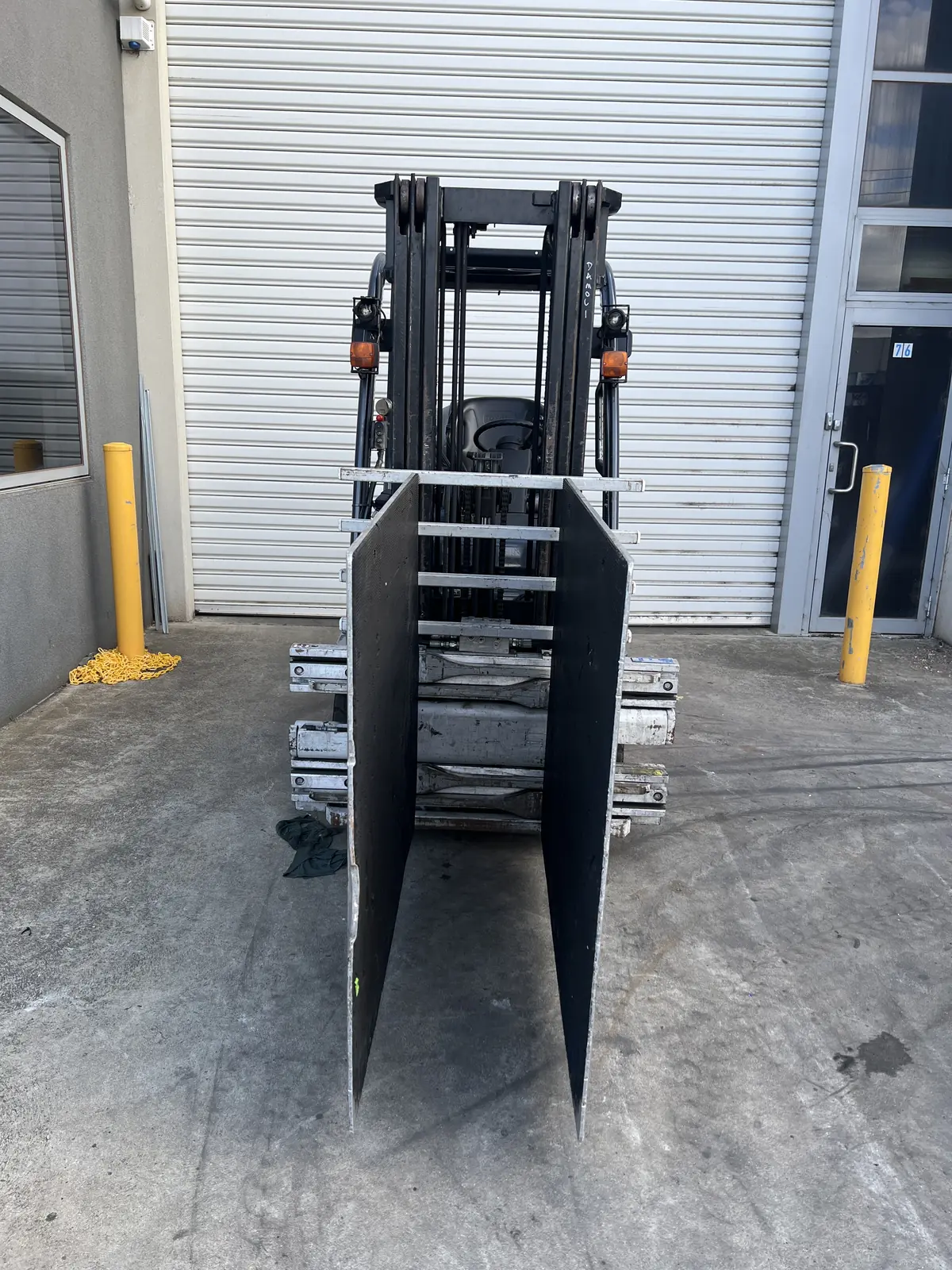
The mast is the upright frame the forks travel up and down. Every mast has a closed height, which is how tall the forklift stands with the forks lowered. A container mast has a lower closed height, so the forklift can drive in and out of a shipping container. A standard mast suits open warehouses and yards, where nothing above the forklift gets in the way.
If you hire a forklift with a standard mast for container work, there’s a real chance it won’t fit through the container doors, or it will only reach the first row of pallets. That means hand-unloading the rest, or a second delivery to swap the machine. When you book, tell us you’re unloading containers and we’ll send a container mast forklift.
Lift height matters too. A container mast still has to put the pallet where it’s going once it’s out of the container, whether that’s the floor, a truck tray or your racking. Measure the height of your highest racking beam and allow clearance above it, then check the forklift’s lift height against that figure. On our used stock, container mast lift heights run from about 3.0 m to 4.7 m, so there’s a range to match different sites.
What capacity do you need for a container?
Capacity is the most important number on a forklift. Start with the heaviest pallet in the container, not the average one. Check the packing list, the supplier’s spec sheet or the consignment note, or ask the shipper for the heaviest pallet weight before the container arrives.
- 1.8 tonne suits lighter pallets and tighter spaces. It’s compact and easy to manoeuvre. See our 1.8 tonne forklift hire page.
- 2.0 to 2.5 tonne is the most common general-purpose size, and it’s the usual pick for container loading and most warehouse and yard work.
- 3.0 tonne suits heavier pallets, building materials, steel and timber. Our hire fleet goes up to 3 tonne. Bigger forklifts are also heavier, so check your floor and aisle widths first.
Two things reduce what a forklift can safely lift. Capacity drops as you lift higher, and long or deep loads move the load centre further out. Attachments such as clamps and fork positioners add weight at the front and reduce usable capacity too. Every forklift has a data plate that shows what it can lift at each height. Check the data plate, or ask us to check it for your load.
Gas or electric for container unloading?
Both work. The choice comes down to where the forklift spends the rest of its day.
Toyota LPG (gas) forklifts
Gas forklifts are the main part of our hire fleet. They’re powerful all-rounders for loading trucks, yards, loading docks and construction sites, and they suit sites where the forklift works inside and outside through the day. Refuelling is a quick gas bottle swap, so there’s no waiting for a charge. LPG forklifts produce exhaust, so they need good ventilation if they spend a lot of time indoors, and a container is an enclosed space. Keep the container doors open and keep the work moving rather than idling inside.
Toyota electric forklifts
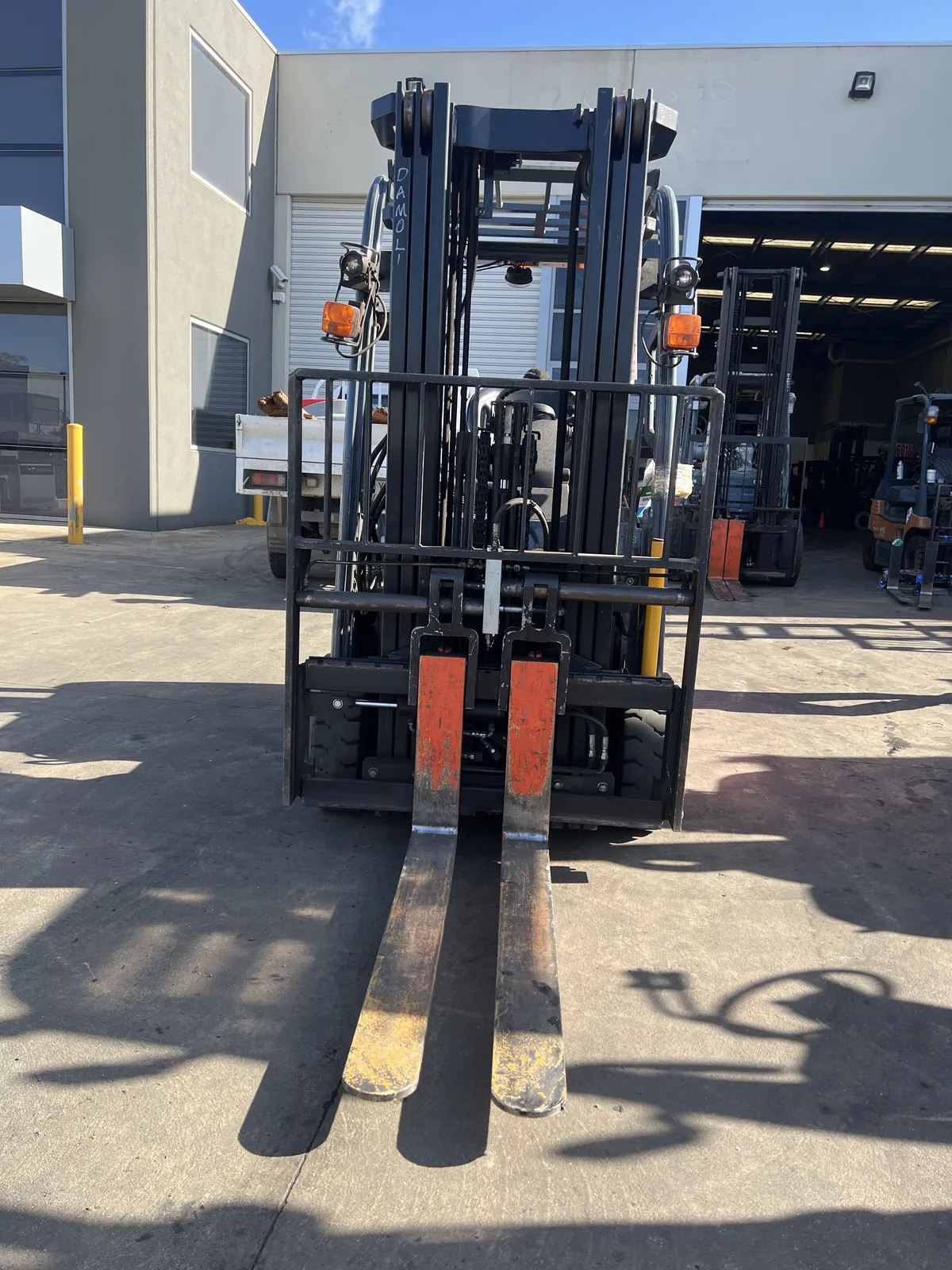
Electric forklifts are quiet, with zero fumes at the point of use, and have good visibility out the back because there’s no gas bottle. That suits container work where the goods go straight into an indoor warehouse or a food site. Toyota four-wheel electric counterbalance forklifts often come with a container mast. Our electric hire forklifts are Toyota, 1.8 to 3 tonne, from $270 a week + GST ($210 on a month or more), and a charger is included with every electric hire. Chargers run off mains power, single or three phase depending on the battery and charger, so let us know what power you have. See electric forklift hire in Melbourne.
For a deeper comparison, read electric vs LPG forklifts.
Before the container arrives: a quick checklist
Containers arrive on a schedule you don’t fully control, so getting the forklift sorted before the container lands takes the pressure off. Have these answers ready when you call:
- The heaviest pallet weight in the container.
- Palletised or loose? Loose cartons change the job, so tell us if the goods aren’t on pallets.
- Where the container will sit: on the ground in your yard, at a loading dock, or still on a trailer. Tell us how it’s being delivered so we can talk through what will work on your site.
- Where the pallets go next: the floor, racking (and the height of the highest beam), or a truck.
- Indoors, outdoors or both, and what the ground is like between the container and the shed.
- One container or a run of them, and roughly how long you’ll need the forklift.
- The delivery address and the date the container lands.
Tell us those things and we’ll match the capacity and mast to the job, then quote the hire plus delivery and pick-up before you book.
One container, a run of containers, or every week?
One container or a short run: short-term hire
Short-term forklift hire covers the jobs that come and go, and a container that’s just landed is the classic example. Minimum hire is generally one week, which gives you room if the container arrives a day or two late. If the work runs longer, keep the forklift longer.
Containers every week: long-term hire
If you import regularly, a forklift on site full time usually makes more sense than booking one each time a container lands. Long-term forklift hire gives you a forklift on site without buying one, with a predictable cost and the option to change capacity if the work changes. Delivery costs less the longer you hire, and on hires over a month you can ask us about reduced delivery. Long-term rates are priced on enquiry, so call 1300 326 654.
Containers for years: consider buying
If you’ll be unloading containers every week for years, owning the forklift may cost less. Many of our used Toyota forklifts already have a container mast. As a guide, recent listings have included Toyota LPG container mast forklifts in 1.8, 2.5 and 3.0 tonne from about $12,650 to $19,800 inc GST, and Toyota electric container mast forklifts in 1.8 and 2.0 tonne from about $11,000 to $14,300 inc GST. Stock changes each week, so check what’s in the yard today.
Our used forklifts come with a 3-year warranty on all units, and finance is available. Browse used forklifts for sale in Melbourne, with the price including GST on each listing, or read our used forklift buying guide. For the full hire range and how rental pricing works, see forklift hire Melbourne and forklift rental Melbourne. Each listing shows the mast type and lift height, so you can spot the container masts at a glance.
Still weighing it up? Read forklift hire vs buying or what forklift hire costs.
What container forklift hire costs in Melbourne
Here’s how our hire pricing works for container jobs:
- Toyota LPG (gas) forklift, 1.8–2.5 tonne: from $190 a week + GST ($160 on a month or more).
- Toyota electric counterbalance forklift: $270 a week + GST ($210 on a month or more), charger included.
- Weekly hire, late-model Toyota 1.8 to 2.5 tonne container mast: $180 to $250 + GST per week. A standard mast can cost less.
- Minimum hire: generally one week.
- Delivery and pick-up: from around $180 + GST, depending on your suburb, quoted before you book.
- Longer hires: call 1300 326 654 for long-term rates.
Servicing and breakdown cover are included for the whole hire. If something goes wrong mid-container, call us and we’ll sort it. You can also set up an account in under 5 minutes: hire now, pay later. What it costs: forklift rental cost in Melbourne.
Safe container unloading
Only licensed operators can legally drive a forklift in Australia, and container work is no exception. If someone on your team needs a licence, our guide on how to get a forklift licence in Australia explains the process.
A few habits keep container days safe:
- Do a pre-start check on the forklift at the start of every shift.
- Check the heaviest pallet against the forklift’s data plate before you start, especially if you’re lifting into racking.
- Open the container doors fully and look at how the load has travelled before driving in.
- Keep people clear of the container doorway while the forklift is working.
- If a forklift isn’t safe to use, tag it out of service and park it out of the way until it’s been looked at.
Already own a forklift for containers?
If your own forklift does the container work, keep it serviced so it doesn’t let you down on the day a container lands. We offer on-site forklift service and repair across Melbourne. We service all makes and models, and we specialise in Toyota. Our service special is $345 + GST (normally $420 + GST), with travel, labour, parts and consumables included, for gas, petrol and electric forklifts up to 3 tonnes, anywhere in Melbourne. If your forklift is off the road, we can often get a hire forklift to you while yours is fixed.
Container forklift hire FAQs
What forklift do I need to unload a shipping container?
For most containers of palletised goods, a 1.8 to 2.5 tonne forklift with a container mast. The container mast has a lower closed height, so the forklift can drive in and out of the container. Check your heaviest pallet weight against the forklift’s data plate.
What is a container mast?
A container mast is a forklift mast with a lower closed height, so the forklift can drive in and out of shipping containers. A standard mast suits open warehouses and yards.
How much does it cost to hire a container forklift in Melbourne?
Weekly hire of a late-model Toyota 1.8 to 2.5 tonne container mast forklift is $180 to $250 + GST per week. Minimum hire is generally one week, and delivery is from around $180 + GST depending on your suburb.
Can I hire a forklift for just one container?
Minimum hire is generally one week, which covers a single container with room to spare if it lands late. Short-term hire is designed for exactly this kind of job.
Can an electric forklift unload containers?
Yes. Toyota electric counterbalance forklifts often come with a container mast, and they have zero fumes at the point of use. Our electric hire forklifts are Toyota, 1.8 to 3 tonne, from $270 a week + GST ($210 on a month or more), with a charger included.
Is delivery included in the hire price?
Delivery and pick-up are extra and quoted up front for your suburb, from around $180 + GST. Delivery costs less the longer you hire, and on hires over a month you can ask us about reduced delivery.
What if the forklift breaks down halfway through a container?
Servicing and breakdown cover are included for the whole hire. Call 1300 326 654 and we’ll sort it.
Do you sell used container mast forklifts?
Yes. Many of our used Toyota LPG and electric forklifts have a container mast. They come with a 3-year warranty on all units, finance is available, and every listing shows the price including GST.
Book a container forklift
Damoli Forklift Services is a family owned and operated Melbourne business, hiring forklifts since 2009, with a hire fleet of 150+ forklifts, mainly Toyota. We deliver across Melbourne from our yards in Werribee and Epping, including the west, the north, the east and the inner suburbs. Werribee is open Monday to Friday, 8am–4pm, and Epping Monday to Friday, midnight to 4pm.
Local pages: forklift hire Werribee, Truganina, Epping, Campbellfield, Laverton North and Port Melbourne.
Tell us the heaviest pallet, where the container will sit and when it lands, and we’ll match the forklift and quote delivery before you book. Call 1300 326 654 or see forklift hire in Melbourne.
A forklift service is more than an oil change. A good service checks the parts that keep the forklift safe and reliable, replaces what’s worn, and picks up small faults before they turn into a breakdown. Here’s what a typical forklift service includes, and how it differs between LPG, petrol and electric forklifts.
Why regular servicing matters
WorkSafe Victoria’s guidance says forklifts and their attachments must be regularly inspected and maintained, and recommends using a suitably competent forklift technician so the forklift keeps operating in line with the manufacturer’s recommendations. Regular servicing helps you:
- Keep the forklift safe for operators and people nearby
- Reduce unplanned breakdowns and downtime
- Catch wear early, when parts cost less to replace
- Keep a service history, which helps resale value
Most forklifts get a scheduled service somewhere between every 250 and 500 hours, or every three to six months. That’s a typical range only. Your manufacturer’s schedule and how hard the forklift works set the right interval.
What’s checked on every forklift
Whatever the fuel type, a scheduled service usually covers these areas.
Mast, chains and forks
The technician checks the mast for wear, damage and smooth operation, inspects the lift chains for stretch, wear and lubrication, and looks over the forks for cracks, bends and heel wear. Chains are adjusted and lubricated as needed.
Hydraulics
Hydraulic fluid level and condition are checked, along with hoses, fittings and cylinders for leaks or damage. Slow lifting, jerky movement or a mast that drifts down can point to a hydraulic fault.
Brakes and steering
Service and park brakes are tested and adjusted, and the steering is checked for play, leaks and smooth operation.
Tyres and wheels
Tyres are checked for wear, chunking and damage, and wheel nuts for tightness. Worn tyres affect stability and braking, so they’re flagged early.
Safety equipment
The seatbelt, horn, lights, reversing beeper or warning devices, overhead guard and load backrest are all checked to make sure they work and aren’t damaged.
Lubrication
Grease points across the mast, steering and chassis are lubricated to reduce wear.
Extra checks for LPG and petrol forklifts
Internal combustion forklifts have an engine to look after, so a service typically also includes:
- Engine oil and oil filter change
- Air filter check or replacement, especially in dusty sites
- Spark plugs and ignition checks, depending on the schedule
- Cooling system: coolant level, radiator and hoses
- Fan belts and drive belts
- Fuel system: on LPG forklifts, the gas bottle bracket, hoses, connections and regulator; on petrol forklifts, fuel lines and filters
- Exhaust system for leaks and damage
Not every item is replaced at every service. Some parts are changed at set hour intervals, so a bigger service may come around every few services.
Extra checks for electric forklifts
Electric forklifts skip the engine work, but the electrical system needs care:
- Battery condition, terminals and cables
- Water levels on lead-acid batteries
- Charger operation and charging connections
- Drive and lift motors
- Controllers, contactors and wiring
If an electric forklift won’t hold its charge through a shift, ask about our battery and charger work.
The test drive and report
A service should finish with a test of the forklift under normal operation: driving, braking, steering, lifting, lowering and tilting. You should then get a clear report of what was done, what was replaced, and anything that needs attention soon. Keep it with your service records. WorkSafe Victoria’s guidance recommends keeping inspection and maintenance records that show what was inspected, any maintenance carried out, and any defects and rectification work.
What a service doesn’t replace
Operators should still do a pre-start check before using the forklift. WorkSafe Victoria recommends a pre-operation inspection, in line with the manufacturer’s recommendations, at the start of each shift, before first daily use and when the operator changes. A service also isn’t a repair: if the technician finds a worn part or a fault, it’s quoted separately so you can decide.
If your forklift has already broken down, see our forklift repairs in Melbourne page. If it’s no longer worth fixing, browse our used forklifts for sale in Melbourne.
Our forklift service in Melbourne
We’ve been servicing forklifts across Melbourne since 2009, and we work on all makes and models, specialising in Toyota.
- Service special: $345 + GST (normally $420 + GST) for gas, petrol and electric forklifts up to 3 tonnes.
- On-site, anywhere in Melbourne. We come to you.
- Multi-unit discounts for sites with more than one forklift.
- Diesel and larger forklifts are serviced too, quoted before the visit.
- Safety inspections, battery and charger work, and petrol forklift repairs are also available.
Read more on our forklift service and repair page, or see your local page: Werribee, Epping, Laverton North, Altona, Thomastown and Broadmeadows.
Need a forklift while yours is serviced?
Most services are done on site without taking the forklift away for long. If a repair keeps it off the road, forklift hire starts from $190 a week + GST with servicing and breakdown cover included. If it’s time to replace an old machine, browse our used forklifts for sale in Melbourne, with a 3-year warranty on all units.
Forklift service FAQs
How much is a forklift service in Melbourne?
Our standard service is $420 + GST, covering labour, travel, parts and consumables. The $345 + GST service special covers gas, petrol and electric forklifts up to 3 tonnes in Melbourne.
Do you service diesel forklifts?
Yes. Diesel and larger forklifts are serviced too, and we quote them before the visit.
Do you discount for more than one forklift?
Yes. Ask about discounts when we service several forklifts on one site.
Which makes do you service?
All makes and models, specialising in Toyota.
Book a service
Tell us the make, model, hours on the meter and your site address. We’ll quote before we come out, and we reply quickly during business hours, Monday to Friday, 8am–4pm.
Call 1300 326 654 or send an enquiry.
Most forklifts in Melbourne workplaces get a scheduled service somewhere between every 250 and 500 hours on the meter, or every three to six months, whichever comes first. That’s a typical range, not a rule. The right interval for your forklift depends on the manufacturer’s schedule, the fuel type and how hard the machine works.
This guide explains the typical intervals, what changes them, and how to set a schedule that suits your site.
The short answer: follow the manufacturer, then adjust for your site
Every forklift comes with a maintenance schedule in its operator or service manual. That schedule is your starting point. WorkSafe Victoria’s guidance says forklifts and their attachments must be regularly inspected and maintained, and recommends engaging a suitably competent forklift technician so the forklift keeps operating in line with the manufacturer’s recommendations.
From there, look at how your forklift is actually used. A machine doing a few pallets a day in a clean warehouse wears very differently to one working two shifts in a dusty yard.
Typical service intervals by forklift type
The figures below are common industry ranges. Always check your manual, because intervals vary between makes and models.
LPG (gas) and petrol forklifts
Internal combustion forklifts have an engine, oil, filters, spark plugs and a cooling system to look after. A typical scheduled service is every 250 hours or about every three months. Heavily used machines often reach 250 hours well before three months are up, so the hour meter is usually the better guide.
Electric forklifts
Electric forklifts have fewer engine parts, so the scheduled service interval is often longer, typically somewhere around every 500 hours or six months. They still need regular checks of brakes, steering, mast, chains, hydraulics and tyres. The battery and charger also need attention: water levels and terminals on lead-acid batteries, and the charging set-up generally.
Older or high-hour forklifts
A forklift with a lot of hours on it may need more frequent attention, because worn parts tend to fail faster. If your forklift is older, ask your technician whether a shorter interval makes sense. If repair bills start adding up, it may be time to look at our used forklifts for sale in Melbourne.
What can shorten the interval
Some conditions put more load on a forklift and are a good reason to service more often than the typical range:
- Long hours or multiple shifts. More hours means more wear, so service by the hour meter rather than the calendar.
- Dust, dirt and debris. Timber yards, landscape supplies, recycling and building sites clog air filters and radiators faster.
- Heavy loads. Regularly lifting close to rated capacity works the hydraulics, mast and tyres harder.
- Rough or uneven ground. Outdoor yards, gravel and ramps are harder on tyres, steering and the mast.
- Cold stores or wet areas. Moisture and temperature swings can affect electrics, brakes and lubrication.
Daily pre-start checks still matter
A scheduled service doesn’t replace the operator’s pre-start check. WorkSafe Victoria recommends a pre-operation inspection, done in line with the manufacturer’s recommendations, at the start of each shift, before first daily use and when the operator changes. Defects should be reported, and a forklift that isn’t safe should be locked out of service until it’s fixed.
A typical pre-start check covers:
- Tyres and wheels for damage or wear
- Forks, chains and mast for cracks, bends or damage
- Hydraulic hoses and fluid leaks
- Brakes, steering, horn, lights and seatbelt
- Gas bottle connections on LPG forklifts, or battery charge and connections on electric forklifts
When operators report small issues early, your technician can often fix them at the next service instead of after a breakdown.
Signs your forklift needs a service now
Don’t wait for the next scheduled date if you notice any of these:
- Fluid leaks under the forklift
- Brakes that feel soft or pull to one side
- The mast lifting slowly, jerking or drifting down
- Unusual noises, smoke or a strong smell
- Hard starting, rough running or loss of power
- An electric forklift that won’t hold its charge through a shift
Our forklift repairs in Melbourne page covers the faults we see most often and how we handle a breakdown.
Keep a service record
WorkSafe Victoria’s guidance says inspection and maintenance records should show what needs inspecting at each interval, what has been inspected, maintenance carried out, and any defects and the work done to fix them. A simple logbook kept with the forklift, or a spreadsheet in the office, does the job. Good records also help when you come to sell or trade the forklift.
How we service forklifts in Melbourne
We’re a family-owned business, servicing forklifts across Melbourne since 2009. We work on all makes and models, specialising in Toyota.
- Service special: $345 + GST (normally $420 + GST) for gas, petrol and electric forklifts up to 3 tonnes, anywhere in Melbourne.
- On-site. We come to your workplace, so the forklift doesn’t leave your site.
- More than one forklift? Ask about multi-unit discounts.
- Diesel and larger forklifts are serviced too, quoted before the visit.
- Battery and charger work, safety inspections and petrol forklift repairs are also available.
See our forklift service and repair page for full details, or find your local page: Werribee, Epping, Truganina, Derrimut and Campbellfield.
Need a forklift while yours is in for work?
If a repair takes your forklift off the road for a while, forklift hire starts from $190 a week + GST, with servicing and breakdown cover included for the whole hire. And if the repair bill doesn’t stack up against the age of the machine, our used forklifts for sale in Melbourne come with a 3-year warranty on all units.
Forklift service FAQs
How much is a forklift service in Melbourne?
Our standard service is $420 + GST, covering labour, travel, parts and consumables. The $345 + GST service special covers gas, petrol and electric forklifts up to 3 tonnes in Melbourne.
Do you service diesel forklifts?
Yes. Diesel and larger forklifts are serviced too, and we quote them before the visit.
Do you discount for more than one forklift?
Yes. Ask about discounts when we service several forklifts on one site.
Which makes do you service?
All makes and models, specialising in Toyota.
Book a forklift service
Tell us the make, model, hours on the meter and where your forklift is, and we’ll quote before we come out. We reply quickly during business hours, Monday to Friday, 8am–4pm.
Call 1300 326 654 or send an enquiry.
Every business that moves pallets ends up asking the same question: should we hire a forklift or buy one? There’s no single right answer. It comes down to how often you’ll use it, how you want to manage cash, and who you want looking after the machine. Here’s how to work it out.
Start with how much you’ll use it
This is the biggest factor by far.
- A few days or weeks a year (a stocktake, a run of containers, a seasonal peak): hiring almost always makes more sense. A forklift you own costs you money every day it sits in the corner.
- Every day, for years: buying, or a long-term hire, starts to look better. The question becomes whether you want to own the asset or have someone else responsible for it.
- Somewhere in between, or you’re not sure yet: hire first. You’ll find out how much you really use it before committing.
The case for hiring
No big upfront cost. You pay for the machine while you’re using it, and your cash stays in the business.
Servicing and breakdowns are looked after. With most hire arrangements, the hire company maintains the machine. At Damoli, servicing and breakdown cover are included for the length of the hire.
You can change machines. If the job changes, so can the forklift: a bigger capacity, an electric unit for indoor work, or a reach truck for new racking.
It covers the gaps. Hire is the quick fix when your own forklift is off the road, or when a big order lands.
The trade-offs: over a long period, hire payments add up, and you never own the machine. Delivery and pick-up usually cost extra, so factor them in. For a rough idea of the numbers, see what forklift hire costs.
The case for buying
Lower cost over the long run if you use it every day. Once it’s paid off, the main costs are servicing, repairs and running costs.
It’s yours. You can fit the attachments you want and use it however your business needs. When you’re done with it, it still has a resale or trade-in value.
No hire terms to manage. No end dates, no returns.
The trade-offs: you need the money up front, or finance. You’re responsible for servicing and repairs. And if your only forklift breaks down, work stops until it’s fixed, unless you have a backup or can hire one quickly.
New or used?
If you’re buying, a good used forklift costs much less than a new one and still has years of work in it, as long as it’s been looked after. Check the machine properly before you buy (our guide on what to check before buying a used forklift walks you through it), and ask what warranty comes with it. Damoli forklifts come with a 3-year warranty on all units, and finance is available.
What forklift hire costs
Here’s how our hire pricing works:
- From $190 a week + GST. Minimum hire is generally one week.
- Weekly from $180 to $250 + GST for a late-model Toyota 1.8 to 2.5 tonne container mast forklift. Standard mast forklifts can cost less.
- Delivery is about $180 + GST, depending on the address.
- Servicing and breakdown cover are included for the whole hire.
That last point matters. With hire, the weekly rate is close to your total cost. You don’t pay separately for scheduled services, and if the forklift breaks down, it’s our job to sort it. Our forklift hire page has the full range. What it costs: forklift rental cost in Melbourne.
What owning a forklift costs
When you buy, the purchase price is only part of the cost. Owning a forklift also means paying for:
- Scheduled servicing. Typically every 250 to 500 hours or every three to six months, depending on the forklift and how it’s used. Our service special is $345 + GST (normally $420 + GST) for gas, petrol and electric forklifts up to 3 tonnes.
- Repairs and wear parts. Tyres, chains, brakes, hoses and batteries all wear out eventually.
- Fuel or power. LPG bottles for gas forklifts, or electricity and battery care for electric ones. You pay this with hire too.
- Insurance and finance costs, if they apply to your business.
On the other side of the ledger, a forklift you own keeps some resale value, and once it’s paid off the ongoing cost is mainly servicing, repairs and fuel.
A simple way to compare
Put the two options side by side over the same period, say three years.
Hire: the hire rate for the period, plus delivery and pick-up.
Buy: the purchase price (or your finance repayments), plus:
- servicing
- repairs and parts
- insurance
- the cost of downtime if it breaks down
- minus what you could sell it for at the end
The numbers will depend on your machine and how hard you work it. Your accountant can tell you how hire costs and an equipment purchase are each treated for tax in your situation, which can shift the answer.
Common situations
- Seasonal peak or end-of-financial-year stocktake: short-term hire
- One-off job, e.g. unloading a few containers: short-term hire
- Your forklift is off the road for repairs: short-term hire
- New business, unsure of demand: hire first, then decide
- One shift a day, every day, for years: buy, or long-term hire
- You want no servicing or repair responsibility: long-term hire
- You need a specific attachment set-up for years: buy
Testing before you buy
Not sure whether you need a container mast, or whether LPG or electric suits your site? Hiring for a few weeks is a low-risk way to find out.
You don’t have to pick just one
Plenty of businesses do both. They own the forklifts they use every day, and hire extra machines for busy periods or when one of theirs is being repaired. It keeps the owned fleet small and avoids paying for machines that sit idle. If buying wins, our used forklift buying guide explains what to check and our current used stock lists each price inc GST. If hiring wins, see forklift hire rates. Comparing both options side by side? Start with forklift hire Melbourne rates and forklift rental Melbourne inclusions (servicing and breakdown cover), then call 1300 326 654.
Local hire across Melbourne
We deliver from our yards at Werribee (Unit 2/76 Riverside Ave) and Epping (55 Produce Drive, Monday to Friday, midnight to 4pm). See our local pages for forklift hire in Werribee, forklift hire in Epping, Truganina, Laverton North, Campbellfield and Thomastown.
Talk it through with us
Damoli sells, hires and services forklifts, so we’re not pushing you one way. Forklift hire starts from $190 a week + GST, with more than 150 machines in the fleet: 1.8 to 3 tonne gas and electric forklifts, plus reach trucks from $280 a week + GST ($220 on a month or more). If buying suits you better, our used forklifts for sale in Melbourne are mainly Toyota, each with a 3-year warranty and finance available. Whichever you choose, we also offer same-day on-site servicing and repairs across Melbourne.
Call 1300 326 654 or get a quote. We reply quickly during business hours. See our forklift hire options.
Life on the warehouse floor reveals an interesting find… Greetings, fearless readers! Today, we embark on an epic journey into the heart of warehouses, where ordinary forklift drivers transform into unsung superheroes. Donning their invisible capes and armed with the mighty forks, these unsung champions of logistics navigate the treacherous terrain of pallets and cardboard boxes to save the day. Yes, you heard it right – forklift drivers are the unsung superheroes we never knew we needed! Shopping for a used forklift? See our guide to used forklifts for sale in Melbourne, with a price guide by capacity.
The Forkmaster: Master of the Forklift Arts
Meet our first superhero, The Forkmaster. With lightning-fast reflexes and the precision of a brain surgeon, The Forkmaster manoeuvres through the narrowest aisles with the grace of a ballet dancer. Also his trusty forklift, equipped with the power to lift pallets of snacks and beverages to dizzying heights, turns him into a one-man party-planning committee. Need those snacks for the office shindig? Fear not, for The Forkmaster is here to elevate your snack game!The Pallet Avenger: Defender of Organised Chaos
Enter The Pallet Avenger, the unsung hero of warehouse chaos. Armed with an uncanny ability to Tetris-stack pallets with unparalleled precision, The Pallet Avenger ensures that the warehouse is a symphony of order in the midst of potential chaos. His arch-nemesis? The unruly stacks of pallets that threaten to topple like a game of Jenga gone wrong. But fear not, for The Pallet Avenger rights the wrongs with his mighty forklift, restoring balance to the warehouse universe.Captain Cargo: The Lifter of the Un-liftable
In the darkest corners of the warehouse, where massive crates loom like insurmountable obstacles, Captain Cargo rises to the occasion. Also he is armed with a forklift capable of lifting the un-liftable, Captain Cargo swoops in to conquer the seemingly impossible tasks. Need a crate of anvils lifted to the top shelf? Captain Cargo has got your back, defying the laws of physics with a nonchalant beep-beep and a hydraulic lift that says, “I got this!”The Whispering Wheels: Stealth Mode Engaged
When silence is golden, and precision is paramount, The Whispering Wheels emerges from the shadows. With a forklift that glides noiselessly across the warehouse floor, The Whispering Wheels can sneak up on pallets and cargo without a creak or a groan. Therefore if you need to transport a load of squeaky rubber chickens without waking the entire office, look no further than The Whispering Wheels, the ninja of forklifts.Forkula: The Shape-shifter of Forklifts
Last but not least, we have Forkula, the shape-shifter of forklifts. Need a regular forklift for routine tasks? Forkula’s got you covered. But what if you suddenly need a forklift that can moonwalk? Forkula can do that too! This shape-shifting superhero adapts to any situation, ensuring that no logistical challenge is too great. Forkula is the forklift we didn’t know we needed but can’t live without. So there you have it, dear readers – the untold tale of forklift drivers, the unsung superheroes of the warehouse. The next time you are looking for forklifts for sale, remember that behind the wheel is a caped crusader, a silent guardian of logistics, ready to save the day with the power of forks and a whole lot of charm.Ready to find your next forklift? Browse Damoli’s full range of used Toyota forklifts for sale in Melbourne. We also offer flexible forklift hire solutions and comprehensive forklift servicing across all makes & models. Contact us or call 1300 326 654.
Confined space can be difficult to navigate at the easiest of times. And, add in the need for a forklift and you’ve really got a challenge ahead of you. Or do you?
Retailers and business owners want to maximise the amount of usable space in their existing warehouse.
One way to do this is by reconfiguring warehouse setups with narrower aisles. Then, all that is required are using very narrow aisle (VNA) material handling units.
So, VNA units are able to operate in smaller width aisles and spaces. This allows for the reclaimed space to be filled with other stock. And the bonus is, it is safe in a confined space.
Confined space: Reach forklifts fit tight spaces
Therefore, let’s look at the leading narrow and tight space units.
Contact now for significant deals on these units.

Always reliable, the Crown is a great choice for a tight space. With a high reach, of almost 7m, you can utilise high space too.

Second, a Linde is understated and often overlooked. But for no good reason, as this machine does very well for you. Getting a quality 2T forklift at a great point.

Also, BT forklift is built to last. A great option that includes a sideshift and a double deep reach for extra high requirements. For tight spaces and high racking, see reach truck hire or forklift hire Melbourne, or browse used forklifts for sale Melbourne.
Forklifts For Sale.
Please contact for discounted wholesale pricing | Incredible deals on forklifts, see our stocklist here…
Invest in assets for your business.

LPG forklift (gas forklift) or a diesel forklift or lithium battery forklift: no matter the requirement, all types are here to stay for a long time. And we have made it our mission to ensure we bring you options for all requirements.
Many of today’s refrigerated and frozen food processors seek alternative power sources for use in warehouse equipment such as forklifts and pallet trucks. If you are weighing up electric options, see electric forklift hire or call Damoli on 1300 326 654 to talk it through.
They do not emit gas during charging, so they do not require special battery rooms. This is especially important for reducing costs associated with battery management. Lithium-ion batteries are also maintenance free, eliminating the need for battery watering and avoids exposure to harmful vapour.
In the years ahead, no one will need to plug, unplug or maintain a battery charging system. But there is still a place for the standard operating LPG forklift (gas forklift) and Diesel forklift.
LPG forklifts have lower upfront costs, as they do not require recharging equipment or batteries. You just need to have a gas bottle handy for when your current bottle runs out. Also, as these forklifts do not require batteries, you won’t need to organise safe battery disposal.
If your business needs a forklift for heavy loads in an outdoor setting, then a diesel forklift may be the right option for your operations.
Diesel forklifts offer the heaviest lifting capacity. Damoli services diesel forklifts too (quoted separately); see forklift service Melbourne. Need a forklift short term? See forklift rental Melbourne.